Field Manual No. 3 · Household money
When prices climb and the bills stack up on the counter,
Pull up a chair.Make a plan.
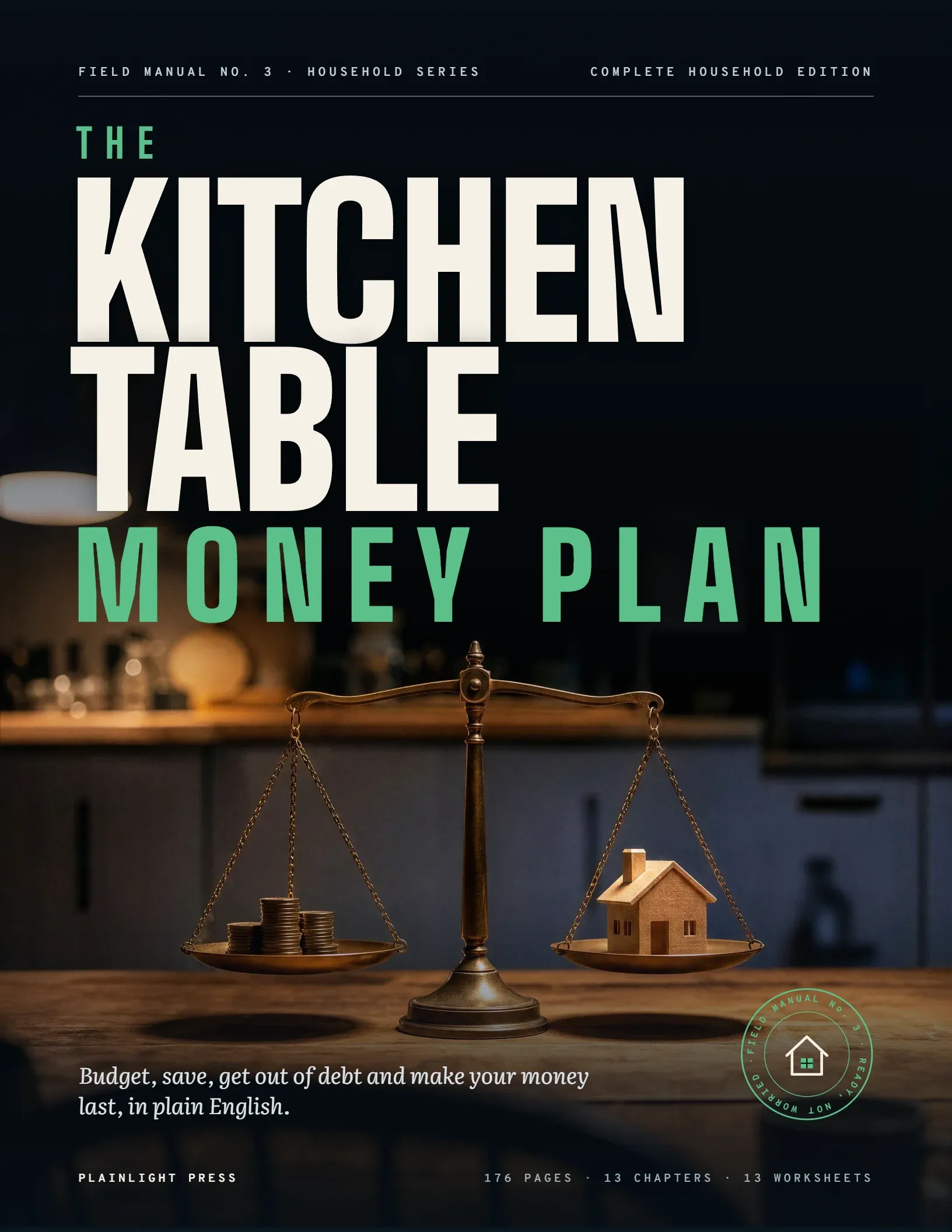
The Kitchen Table Money Plan is a 176-page field guide to budgeting, saving, getting out of debt and making your money last, in plain English: a simple method, a budget you can live with, and a 30-day plan you can start this week. Education, not sales pitches.
- Instant PDF download
- Prints on any home printer
- 30-day money-back guarantee
How the manual works
One table.
Three cushions.
The book’s plan follows five steps: see it, plan it, cushion it, clear it and protect it. Its emergency-fund chapter uses three common milestones. They’re goals, not rules, and your household decides what fits. Each one turns more of life’s surprises into inconveniences.
A small fund for the surprise car repair or appliance, so one bad week doesn’t land on a credit card.
- Helps with
- Small surprises
- Built by
- A little each payday
- See
- Chapter 4
Enough to cover a month of essential expenses: housing, food, utilities, insurance and getting to work.
- Helps with
- A short gap in income
- Built by
- Steady, automatic saving
- See
- Chapter 4
A deeper cushion many financial educators suggest for job loss, illness or other big disruptions.
- Helps with
- Job loss, illness, big repairs
- Built by
- Patience and the plan
- See
- Chapter 4
- 176pages
- 13chapters
- 10master checklists
- 13printable worksheets
- 30day action plan
Try it yourself
Your month,
on one page.
This is the first page of the Kitchen Table Method: write down what comes in and what goes out. The numbers below are an example; replace them with your own. Nothing you type leaves this page.
Left over each month
$0
- Housing 0%
- Utilities & phone 0%
- Groceries 0%
- Transportation 0%
- Insurance & health 0%
- Debt payments 0%
- Everything else 0%
Your cushion milestones
- Cushion 1 · Starter
- Any amount, to start
- Cushion 2 · One month
- $0
- Cushion 3 · Three to six months
- $0
A small fund for the surprise repair. Start with whatever you can set aside each payday.
One month of the essentials above: everything except “Everything else.”
A deeper cushion many financial educators suggest for job loss or illness.
A teaching tool, not financial advice. Chapter 3 walks through a full budget, and Chapter 4 explains how to build each cushion.
Look inside
Real pages.
Real steps.
These are actual pages from the manual: large, clear type, worked examples and worksheets with room to write. Select any page to see it full size.
What’s inside
Every chapter,
page by page.
Thirteen chapters in five parts that follow the Kitchen Table Method: see where your money goes, plan it, cushion it, clear your debts and protect what you’ve built, then make it last. Open any chapter to see what it covers.
- Pages
- 176
- Chapters
- 13
- Worksheets
- 13
- Day plan
- 30
See It and Plan It
p. 1001Pull Up a ChairWhy a Plain Plan Beats a Perfect Onep. 11
“A plain plan you keep beats a perfect plan you don't.”
You will learn
- Why money worries are common, and what helps
- The five steps of the Kitchen Table Method
- How this book is organized and how to use it
- Setting up a regular money night at home
- What this book is, and when to call a professional
Sections
- You're in Good Company
- It's Never Too Late to Start
- The Kitchen Table Method
- Set Up Your Money Night
- Education, Not Advice
02See Where It GoesTracking Your Money Without the Headachep. 19
“You can't steer money you can't see.”
You will learn
- The 30-day spending snapshot: paper, spreadsheet or app
- Reading bank and credit card statements
- Fixed, flexible and irregular expenses
- The subscription and autopay audit
- What your numbers are telling you, without guilt
Sections
- The 30-Day Spending Snapshot
- Reading Your Statements
- Sorting Your Spending
- The Subscription and Autopay Audit
- What the Numbers Tell You
03The Kitchen Table BudgetA Plan You Can Live Withp. 29
“A good budget is one you can actually live with.”
You will learn
- Four budget styles explained plainly, and how to choose
- The 50/30/20 rule of thumb and where it falls short
- Budgeting on irregular income or a fixed retirement income
- Sinking funds for bills that arrive once or twice a year
- Making a budget work for two, and the monthly check-in
Sections
- Start With Your Real Numbers
- Four Budget Styles, Explained Plainly
- Budgeting When Income Bounces Around
- Budgeting on a Fixed Retirement Income
- Sinking Funds for the Bills That Ambush You
- Making It Work for Two or More
- The Monthly Money Check-In
Cushion It
p. 3904Your Emergency CushionMoney for the Days Things Go Wrongp. 40
“A cushion doesn't stop the bump. It softens the landing.”
You will learn
- Why a cushion turns a crisis into an inconvenience
- Three common milestones, from starter to six months
- How much makes sense for your household
- Where people keep it, and how deposit insurance works
- Building it a little at a time, on autopilot
- What counts as an emergency, and refilling afterward
Sections
- Why a Cushion Matters
- Three Common Milestones
- How Much Is Reasonable for Your Household
- Where People Commonly Keep It
- Building It a Little at a Time
- What Counts as an Emergency
- Refilling It After You Use It
05Spend Less Without Feeling PoorLowering Bills the Smart Wayp. 50
“Trim what you never notice and keep what you love.”
You will learn
- How to call a provider and ask for a lower bill
- Energy, grocery and car savings that don't feel like deprivation
- Assistance programs worth a phone call
- Savings traps: buy now pay later, warranties and membership upsells
Sections
- The Phone Call That Pays
- Warm, Cool and Connected for Less
- Groceries and the Kitchen
- Getting Around for Less
- Help Worth a Phone Call
- Savings Traps to Sidestep
- Put the Savings to Work
Clear It
p. 5906Know What You OweDebts, Interest and Your Credit Reportp. 60
“Every payoff plan starts with one honest list.”
You will learn
- Putting every debt on one page
- APR and compound interest in plain arithmetic
- A worked example of the minimum-payment trap
- What your credit report says and who reads it
- Credit scores without the mystery
- Finding and disputing errors, step by step
Sections
- Put Every Debt on One Page
- How Interest Really Works
- The Minimum-Payment Trap
- Your Credit Report: The Record Lenders Read
- Credit Scores Without the Mystery
- Finding and Fixing Errors
07Pay It DownA Steady Plan for Getting Out of Debtp. 70
“Debt is a problem to solve, not a verdict on you.”
You will learn
- Snowball and avalanche, compared as options
- Talking to creditors and asking about hardship help
- What nonprofit credit counseling and debt management plans are
- Red flags of debt-settlement and debt-relief scams
- Your rights with debt collectors, and how medical bills differ
- What a bankruptcy attorney does, and when to ask
Sections
- Start With Your Monthly Number
- Two Popular Ways to Order Your Payments
- Talking to Your Creditors
- Nonprofit Credit Counseling and Debt Management Plans
- Red Flags: Debt-Settlement and Debt-Relief Scams
- Your Rights With Debt Collectors
- Medical Bills Are a Special Case
- When to Talk to a Bankruptcy Attorney
Protect It
p. 8008Insurance in Plain EnglishWhat Your Policies Actually Dop. 81
“A policy is a promise. Know exactly what it promises.”
You will learn
- What each common kind of insurance is for
- Medicare's parts and the long-term care gap
- Premiums, deductibles, limits and exclusions, decoded
- A once-a-year insurance review at the kitchen table
- Questions to ask an agent before you sign
- Shopping for coverage without the pressure
Sections
- The Basic Bargain
- What Each Policy Is For
- Reading a Policy Without Nodding Off
- The Annual Insurance Review
- Questions to Ask an Agent
- Shopping Without Pressure
09Guard the MoneyFraud, Exploitation and Safe Bankingp. 92
“A few quiet habits protect a lifetime of savings.”
You will learn
- How money scams work and the pattern they share
- Account alerts, a credit freeze and a trusted contact
- A two-person rule for big transactions
- Warning signs of financial exploitation, and where to report
- What to do the day you realize money is gone
Sections
- How Money Scams Work
- Lock the Doors on Your Accounts
- Two Sets of Eyes
- When Someone Takes Advantage
- If Money Is Already Gone
10Papers in OrderDocuments, Beneficiaries and the Where-Is-Everything Filep. 100
“Order on paper now saves your family guesswork later.”
You will learn
- The papers every household should be able to find
- How to build a Where-Is-Everything file
- Why a beneficiary form can outrank a will
- Wills, trusts and powers of attorney in plain words
- Leaving digital accounts and passwords safely
- How to talk it over with your family
Sections
- The Papers Worth Gathering
- Where to Keep Them
- Build Your Where-Is-Everything File
- Beneficiary Forms Can Outrank Your Will
- Wills, Trusts and Powers of Attorney
- Digital Accounts and Passwords
- Talking It Over With Your Family
Make It Last
p. 10811Retirement Income, ExplainedUnderstanding the Piecesp. 109
“Lay every piece on the table before you decide anything.”
You will learn
- The five pieces of retirement income and how they fit
- How Social Security claiming ages work, in plain numbers
- Spousal and survivor benefits every couple should understand
- Required minimum distributions, and why withdrawals need a pro
- Medicare's enrollment clock and budgeting for health costs
- Questions for a fee-only fiduciary and how to check backgrounds
Sections
- The Five Pieces on the Table
- Social Security: How Claiming Age Works
- Spousal and Survivor Benefits
- Pensions and Retirement Accounts
- Required Minimum Distributions
- Medicare's Enrollment Clock
- Getting Good Help
12Big Decisions at the Kitchen TableSlow Down, Write It Down, Ask Two Questionsp. 121
“A good decision can survive a night's sleep.”
You will learn
- A three-habit method for any big decision
- Cars and home repairs: what they really cost
- Downsizing and moving: the numbers to run first
- Helping family without hurting yourself
- Reverse mortgages and other high-stakes products
- Saying no to high-pressure sales
Sections
- Three Habits for Any Big Decision
- Cars: Repair, Replace or Keep Going
- Home Repairs: Roofs, Furnaces and Foundations
- Downsizing and Moving
- Helping Adult Children and Grandchildren
- Reverse Mortgages and Other High-Stakes Products
- Saying No to High-Pressure Sales
13The 30-Day Kitchen Table PlanOne Small Job a Day for a Monthp. 129
“One small job a day; in a month, you have a plan.”
You will learn
- How the thirty days are organized
- Week 1: see where your money goes
- Week 2: build a plan you can live with
- Week 3: start your cushion and tackle debt
- Week 4: protect it, then review
- A year-round money calendar
Sections
- The Year-Round Money Calendar
Print, Post & Keep
Who it’s for
Written for real kitchen tables, not Wall Street.
This manual is for you if…
- You want to know exactly where your money goes each month, without spreadsheets or apps.
- You’d like a budget you can actually live with, and a cushion for the days things go wrong.
- You want a steady plan to pay down debt, and to understand interest and your credit report.
- You’re thinking about insurance, retirement income and getting your papers in order.
- You like plain English, large type and worksheets you can fill in at the table.
It is not…
- Financial, investment, tax or legal advice. It teaches how money works and which questions to ask.
- A get-rich-quick scheme. No tips, no hype, no products to buy.
- A lecture. Good people end up in debt; there’s no shame in it here.
- A substitute for a fee-only fiduciary planner, a tax professional or an attorney.
- 01
Calm, not pressure
Money decisions made in a hurry are usually the expensive ones. This book teaches you to slow down and plan.
- 02
Plain English, real numbers
Every term is explained the first time it appears, with worked examples instead of jargon.
- 03
Built on official sources
Drawn from the Consumer Financial Protection Bureau, the FTC, the FDIC, the Social Security Administration, Medicare and the IRS.
The Kitchen Table Money Plan provides general financial education, not financial, investment, tax or legal advice. It is an independent publication, not affiliated with or endorsed by any agency named above.
Get the manual
Everything in one book. One price.
- Format
- PDF, instant download
- Page size
- US Letter, 8.5 × 11 in
- Pages
- 176
- Works on
- Computer, tablet, phone
- Printing
- Any home printer
- Navigation
- Clickable contents & bookmarks
- The Kitchen Table Money Plan176-page PDF, Complete Household Edition
- 13 chapters in 5 partsBudgeting, saving, debt, credit, insurance, fraud, documents and retirement income
- Money Trouble? Start HereA help index that points you to the right page fast
- The 30-Day Kitchen Table PlanOne short task a day, with the time and cost of each
- Master checklistsMonthly, yearly and before-you-sign lists, ready to print
- 13 printable worksheetsMonthly budget, spending tracker, bills calendar, debt payoff plan and more
- Quick reference & resourcesRules of thumb, your rights and free places to get help
One-time payment · No subscription
Instant download. Gumroad shows your download link right after checkout and emails it to you with your receipt.
30-day money-back guarantee
Read it, print it and put it to work. If the manual isn’t right for your household, reply to your Gumroad receipt within 30 days of purchase for a full refund.
Better value
Get all three manuals for $597 (save $231)
The Complete Library adds The Home Front Manual and The Digital Front Door.
Secure checkout by Gumroad, the seller of record for every order.
Questions
Straight answers.
Still deciding? Here is what people usually ask before they order.
Is this financial advice?
No. It’s financial education: it explains how budgets, savings, debt, credit, insurance and retirement income work, and which questions to ask. It never tells you what to buy, sell or invest in. For decisions about investments, taxes, insurance or legal matters, talk with a qualified professional.
Do I need a spreadsheet or an app?
No. Everything works with a pencil, a calculator and the printable worksheets. If you prefer a spreadsheet or your bank’s tools, the same steps apply.
We’re already behind on bills. Is it too late?
No. The Start Here page sends you to the right chapter, including how to talk with a company before a due date, your rights with debt collectors, and a steady plan to pay debts down.
Is it only for retirees?
No. It’s written for adults of any age who run a household. The retirement chapter explains Social Security, pensions, savings and Medicare in plain English for anyone planning ahead.
Does it push any products?
No. It recommends no brands, funds, cards or advisers, and sells you nothing else.
Where do the facts come from?
From official sources such as the Consumer Financial Protection Bureau, the Federal Trade Commission, the FDIC, the Social Security Administration, Medicare and the IRS. Figures are labeled with the year they apply to, because rules change.
How do I get my book after I order?
Checkout is handled by Gumroad. Right after you pay, Gumroad shows your download link and emails you a receipt with the link, so you can download the PDF again any time.
What format is it? Can I print it?
It’s a PDF laid out on US Letter pages (8.5 × 11 in). It works on computers, tablets and phones, with a clickable table of contents and bookmarks, and it prints on any home printer.
What if it isn’t right for my household?
You’re covered by a 30-day money-back guarantee. Reply to your Gumroad receipt or use our contact page within 30 days of your purchase for a full refund.
Can I print copies for my family?
Your purchase covers your household. Print as many copies of the checklists, worksheets and quick-reference pages as your household needs.
Is it political?
No. There’s no politics in any of our books, just practical steps.
Is checkout secure?
Yes. Gumroad processes every order through an encrypted checkout and acts as the seller of record, handling payment and sales tax. We never see your card details.
Can I get all three manuals together?
Yes. The Complete Library includes all three manuals for $597, $231 less than buying them one at a time at $276 each.
Start at the table
Ready,
not worried.
Thirty days from now, you can know where every dollar goes, have a cushion started and a plan for your debts, one short task at a time.
Get the Manual $276